

Your dog is scooting, licking, or giving off that unmistakable fishy smell and you are pretty sure it is an anal gland problem. Now what? Do you take them to the vet? Ask the groomer to handle it? Try it yourself at home?
The answer depends on your dog's specific situation, and getting it wrong can mean incomplete relief, unnecessary expense, or even making the problem worse. This guide breaks down your three options so you can make the right call for your dog.
Does Your Dog Actually Need Anal Gland Expression?
Before deciding where to go, make sure expression is actually needed. Most healthy dogs with firm, consistent stool express their glands naturally during every bowel movement. No manual help required. Routine expression "just in case" can actually cause problems, including chronic inflammation and reduced natural gland function over time.
Expression is appropriate when your dog is showing clear signs of gland fullness or discomfort:
- Scooting — dragging the rear across the floor or grass
- Excessive licking or biting — focused on the tail base, rear end, or perianal area
- Persistent fishy odor — a strong smell that does not resolve with bathing
- Visible swelling — around the 4 o'clock and 8 o'clock positions relative to the anus
- Straining during bowel movements — pain, difficulty, or reluctance to defecate
- Reluctance to sit — shifting weight, standing instead of sitting, or yelping when sitting down
If your dog shows none of these signs, the glands likely do not need expression, regardless of what you have heard about breed-specific schedules or grooming routines.
Option 1: Veterinary Anal Gland Expression
A veterinary visit is the most thorough option and the only one that includes a medical assessment of the glands themselves. This is the best choice when your dog is showing signs of pain, swelling, abnormal discharge, or recurring gland issues.
What happens during a vet visit
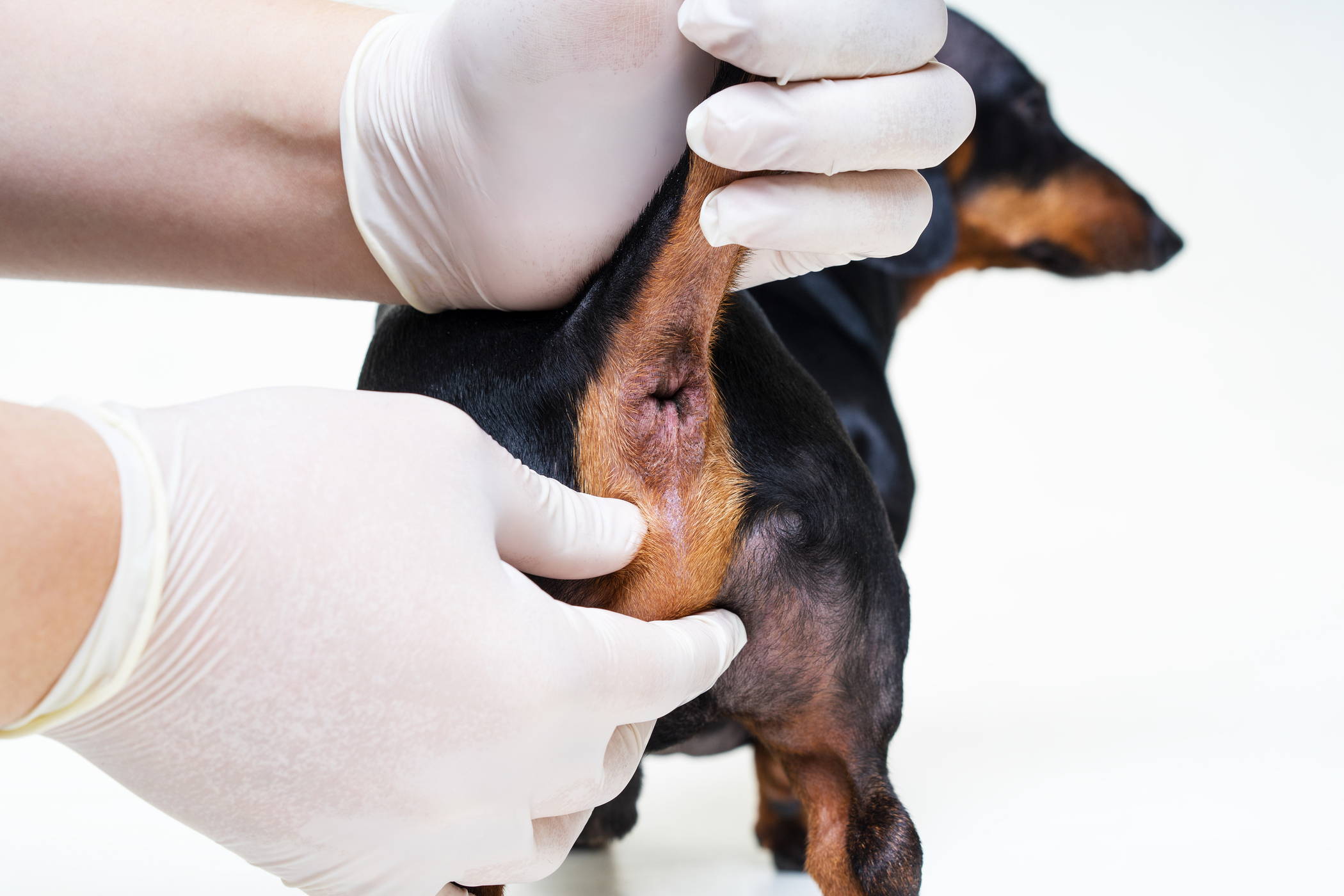
Veterinarians and veterinary technicians use internal expression. A gloved, lubricated finger is inserted into the rectum to palpate each gland individually. This allows the vet to squeeze each sac against the thumb on the outside for a more complete emptying than external pressure alone can achieve.
During the procedure, the vet also evaluates the fluid's color and consistency. Normal fluid ranges from thin and brownish to a slightly thicker paste. Thick, paste-like fluid may indicate early impaction. Yellowish, greenish, or bloody discharge signals infection or abscess, which are conditions that require treatment, not just expression.
A routine expression takes just a few minutes and is generally well-tolerated, though some dogs may be uncomfortable or anxious.
When to choose the vet
- Your dog is in visible pain or the area is swollen, hot, or red
- You see blood, pus, or unusual discharge from the anal area
- Your dog needs expression frequently (more than once every few weeks)
- The glands have not responded to at-home or groomer expression
- You want a complete assessment, not just expression
- Your dog has a history of anal gland problems, infections, or abscesses
Typical cost
A basic veterinary anal gland expression typically costs $25 to $50. If an exam is included, expect $50 to $100. If complications like infection or abscess are discovered and require treatment such as antibiotics, medicated flushes, or drainage, costs can range significantly higher depending on severity.
Option 2: Groomer Anal Gland Expression
Many groomers offer anal gland expression as a standard part of a full-service bath or groom, or as an add-on service. It is a lower-cost option, but it comes with important limitations.
What happens at the groomer
Groomers perform external expression only. This means applying pressure to the outside of the glands using the thumb and forefinger, squeezing inward and upward toward the anal opening. No finger is inserted into the rectum.
External expression can relieve mild fullness, but it does not empty the glands as completely as the internal method performed by a vet. Groomers also are not trained or equipped to assess the fluid, diagnose infection, or detect abnormalities like tumors.
When to choose the groomer
- Your dog has mild, occasional fullness with no signs of pain or infection
- The glands have been recently checked by a vet and confirmed healthy
- You want expression included as part of a routine grooming appointment
- Your dog has no history of recurring anal gland complications
When to skip the groomer
- Your dog is showing signs of pain, swelling, or infection
- The area looks red, hot, or has visible discharge
- The glands feel very firm or are not releasing fluid with gentle external pressure
- Your dog has needed expression more than once in the past month
If a groomer attempts expression and the fluid is thick, bloody, or will not release easily, they should stop and refer you to a veterinarian.
Typical cost
Groomer expression typically costs $7 to $20 as a standalone service, and is often included in the price of a full-service bath or groom.
Option 3: At-Home Anal Gland Expression
Some pet parents learn to express their dog's glands at home using the external method. This can work for dogs with mild, predictable fullness and no history of complications, but it is not the right choice for every dog or every situation.
When at-home expression is appropriate
- Your dog has been evaluated by a vet and the glands are confirmed healthy
- You have been taught the proper technique by your vet or a trained professional
- The fluid releases easily with gentle external pressure
- Your dog tolerates the procedure without significant distress
When at-home expression is not appropriate
- You notice blood, pus, or any abnormal discharge
- The glands feel very hard, do not release fluid, or your dog reacts with intense pain
- You have never had the technique demonstrated by a professional
- Your dog has a history of infections, abscesses, or impactions
For a detailed step-by-step walkthrough of the external at-home method, including supplies, positioning, and cleanup, see our guide: How to Express Dog Anal Glands at Home.
Quick Comparison: Vet vs. Groomer vs. At Home
| Veterinarian | Groomer | At Home | |
|---|---|---|---|
| Method | Internal (rectal) | External only | External only |
| Completeness | Most thorough | Partial | Partial |
| Can assess fluid | Yes | No | Limited |
| Can detect infection | Yes | No | No |
| Typical cost | $25 to $100 | $7 to $20 | Free |
| Best for | Pain, swelling, recurring issues, first-time assessment | Mild fullness, routine maintenance | Trained owners, mild cases |
How Often Do Dogs Need Anal Gland Expression?
There is no universal schedule. The right frequency depends entirely on your individual dog. Some dogs need expression every few weeks, others once or twice a year, and many dogs never need it at all.
If your dog needs expression more than once a month, that is a signal that something else is going on: soft stool, food sensitivities, excess weight, or an anatomical factor that prevents natural emptying. Rather than increasing the frequency of manual expression, the goal should be addressing the underlying cause.
Over-expressing can itself become a problem. Repeated manual pressure on the glands can cause chronic inflammation, scar tissue in the ducts, and a dependency cycle where the glands become less efficient at emptying naturally.
How Anal Gland Expression Is Performed
In this video, we demonstrate the proper technique for expressing dog anal glands safely. This is a graphic but informative resource designed to help pet parents understand the process and recognize when their dog needs help.
How to Reduce the Need for Expression Altogether
The long-term goal is not choosing between the vet, the groomer, and your bathroom. It is helping your dog's glands empty on their own. The single most important factor is firm stool. Firm stool creates the natural pressure needed to squeeze the anal sacs during every bowel movement.
Support firm stool with targeted fiber
Glandex Soft Chews are formulated with a patented blend of soluble and insoluble fiber, plus prebiotics and probiotics, specifically designed to promote the firm, bulky stool that supports natural anal gland function. For more dietary strategies, see 7 foods that help dogs express their anal glands.
Maintain a healthy weight
Excess weight pushes the glands deeper and reduces the muscle tone needed for natural expression. Regular exercise and proper portion control keep the glands accessible and the pelvic muscles strong.
Address underlying allergies
Food and environmental allergies cause perianal inflammation that can block the gland ducts. If your dog has chronic anal gland issues alongside itchy skin or ear infections, talk to your vet about allergy testing or an elimination diet.
Keep the area clean
After expression or if you notice leakage, clean the perianal area to prevent secondary irritation and infection. Glandex Wipes use natural enzymatic deodorizers to neutralize anal gland odor and soothe the skin.
 ``` ---