


Understanding how your dog's joints work can help you appreciate why joint health matters at every stage of life. Joints are the connectors that join inflexible bones together, enabling the flexible movement that allows your dog to run, jump, play, and explore. They provide range of motion and act as shock absorbers during high-impact activities.

The Three Types of Joints in Dogs

Synovial joints (also called free-moving joints) are the most common type. They enable your dog to move and transfer weight from one part of the body to another — running, changing direction, and moving back and forth. Synovial joints are found in the shoulders, hips, elbows, wrists, knees, and ankles.
Fibrous joints (also called fixed joints) are found in areas where minimal movement is needed, such as the skull. These joints are connected by tough, fibrous tissue. A dog's skull is made up of multiple bones, all held together by this fibrous tissue.
Cartilaginous joints allow limited movement and are found in areas like the spine, where bones are joined by cartilage. These joints have less range of motion than synovial joints — examples include the joints between the vertebrae and the joints where the ribs meet the sternum.
How Synovial Joints Work
Because synovial joints are the primary joints that enable your dog's full range of movement, understanding their structure is helpful for understanding joint health.
Where two bones meet in a synovial joint, the connection is protected by a tough joint capsule. Outside the capsule, soft tissues, tendons, ligaments, and muscles surround the joint. These structures work together to protect the joint and enable it to move.
Inside the joint capsule, the ends of the bones are cushioned and protected by a thin layer of cartilage. This cartilage provides a smooth, friction-free surface that allows the joint to move without bone-on-bone contact. Cartilage provides the flexibility, lubrication, and cushioning that help your dog handle the impact of running, jumping, and playing.
Synovial fluid inside the joint capsule provides additional protection. This slippery, viscous fluid contains Hyaluronic Acid — a gel-like molecule that works as a lubricant and helps absorb shocks to cushion the joint further.
The Shoulder Joint
Unlike humans, dogs do not have a collarbone. Their shoulder blades are connected to the skeleton by a series of muscles rather than bones. This muscle-based connection allows dogs greater speed and agility — the powerful back legs propel the body forward while the shoulders extend to increase stride length.
The shoulder joint itself is a ball and socket joint, where the ball at the top of the humerus (the upper front leg bone) meets the scapula (shoulder blade). This type of joint allows for a wide range of movement and absorbs significant force every time a dog jumps and lands.
Understanding Dog Anatomy in Human Terms
To visualize where a dog's joints are located, imagine a person on all fours. The elbows and wrists would be at the front, and the knees and ankles would be at the back. The same applies to dogs.
The Elbow Joint
The elbow joint is located just below the chest on the front legs — the joint further down the leg that may appear to be the elbow is actually the wrist. The elbow is where three bones meet: the humerus (upper foreleg), and the radius and ulna (lower foreleg). It is a hinge joint, meaning it moves in one direction, unlike a ball and socket joint that allows a wider range of motion. The elbow joints absorb considerable force, particularly when a dog brakes or comes to a sudden stop.
The Wrist Joint
The wrist joint, also called the carpus, is located between the elbow and the paw on the front legs. Here, the bones of the upper leg meet with seven small carpal bones. This intricate system helps your dog stop, stand, and move freely.
The Hip Joint
The hip joints are ball and socket joints that work hard every day. Each time a dog jumps, plays, runs, or climbs stairs, the hip joints are activated. Inside the joint, synovial fluid cushions the movement while the layer of cartilage over the bone ends adds extra protection.
The Knee Joint (Stifle)
The knee joint, also known as the stifle, is located in the hind legs and is one of the largest synovial joints in a dog's body. It plays a crucial role in enabling a dog to stand up, jump onto furniture or into a vehicle, walk, run, and play.
The Ankle Joint (Hock)
The ankle joint, also called the hock, connects the shin bones to the paws. Dogs that love to run or jump place extra pressure on this joint as it flexes and adapts to intense movement.
How Aging Affects Your Dog's Joints

As dogs age, the body produces less synovial fluid and the cartilage in the joints can gradually wear down from natural use over time. The result can be stiff joints and reduced mobility. This is why joint support becomes increasingly important as your dog gets older.
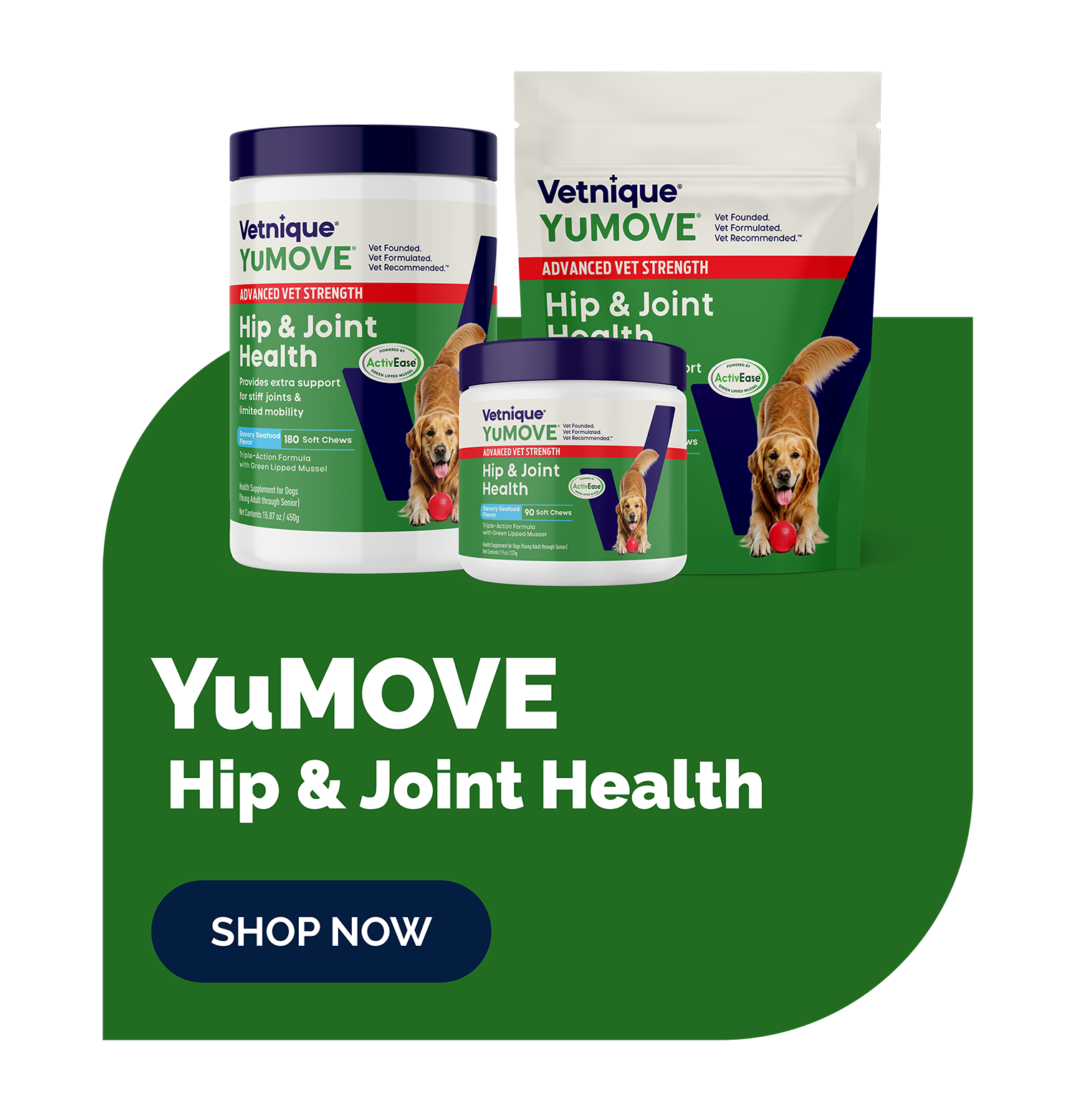
A joint supplement formulated with key ingredients can help support comfort and mobility. A study by the Royal Veterinary College found that YuMOVE's formula — which combines ActivEase Green Lipped Mussel (providing Omega-3 fatty acids to ease stiffness), Glucosamine (providing the building blocks of cartilage to support joint structure), and Hyaluronic Acid (supporting the synovial fluid that lubricates and cushions joints) — made a measurable difference in dogs within six weeks.
For dogs with severe or chronic stiffness, YuMOVE Advanced Vet Strength Chews provide the most concentrated formula. For general daily joint maintenance, YuMOVE Tasty Health Bites offer preventive support. For dogs that prefer a tablet format, YuMOVE AVS Tablets are also available. Browse the full YuMOVE hip and joint collection to find the right option for your dog.